 TicTacToe100
On this page: Rules · Moving around the board · Easy, Medium and Hard · Buttons · Strategy · FAQ
Tic Tac Toe 100x100 rules: 5 in a row wins
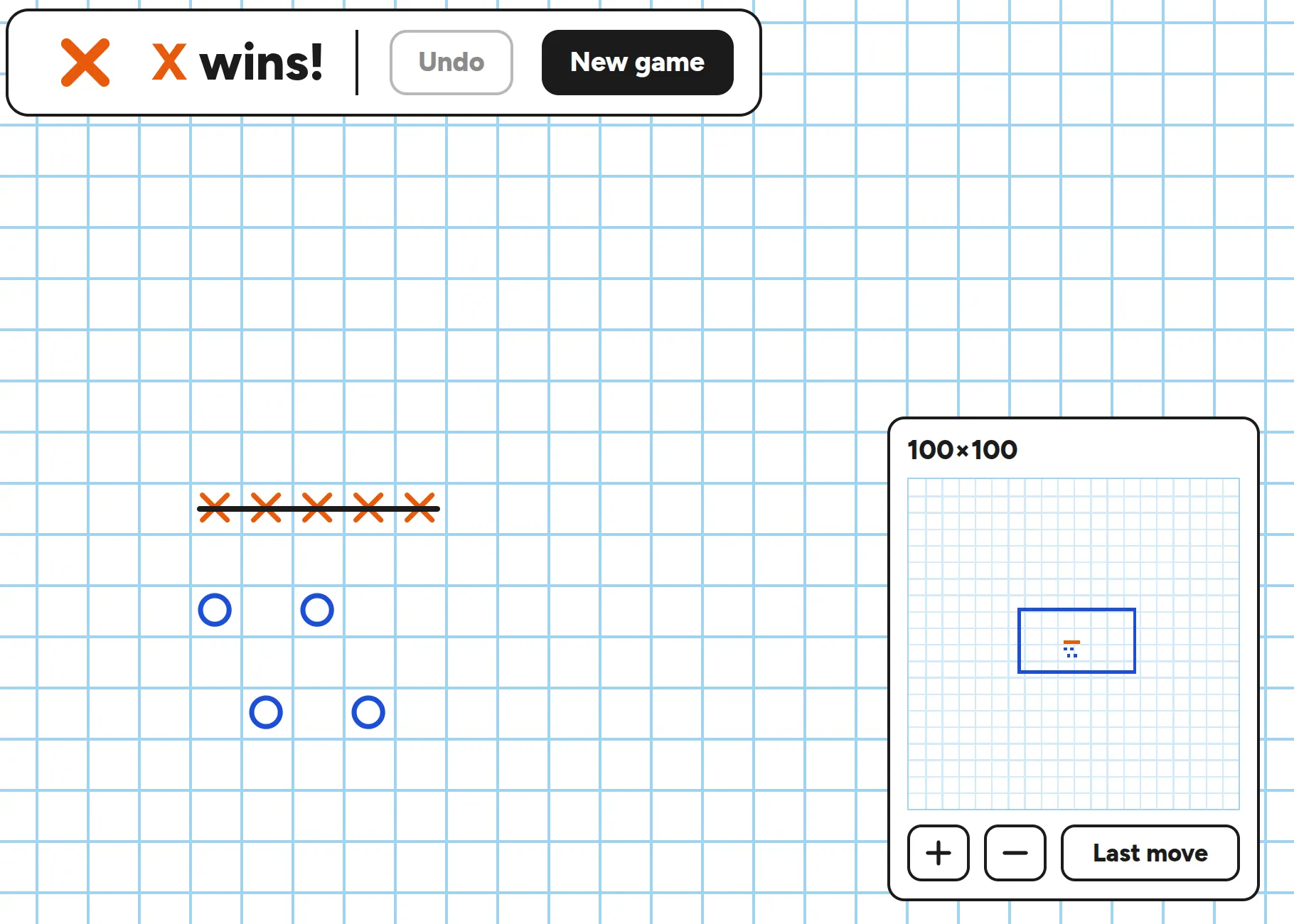
Tic Tac Toe 100x100 is a game for two players, X and O, on a board of 100 rows and 100 columns. You win by getting five of your marks in a row, across, down or diagonally.
- X moves first in the first game. After that, the first move changes sides with every new game.
- Players take turns. On your turn, mark any empty square.
- Five or more of your marks in a row win the game. A line of six counts, and this page does not look at what sits at the ends of the line: five in a row wins even with your opponent's marks at both ends.
- If all 10,000 squares fill with no line of five, the game is a draw. In 300 games of random moves on this page's rules code, none ended that way.
With five needed, a 100×100 board has 37,632 places where a line of five can sit. The 3×3 board has 8 lines of three.
How it differs from Gomoku
Five in a row on a large board is also the idea behind Gomoku. This page is the tic tac toe version: a 100×100 board, five or more wins, no choice of rules and no opening trick. The Gomoku page on this site has a smaller board and lets you pick its rules. If you want four in a row instead, the 5x5, 6x6 and 7x7 boards on this site need four.
Moving around a 100x100 board
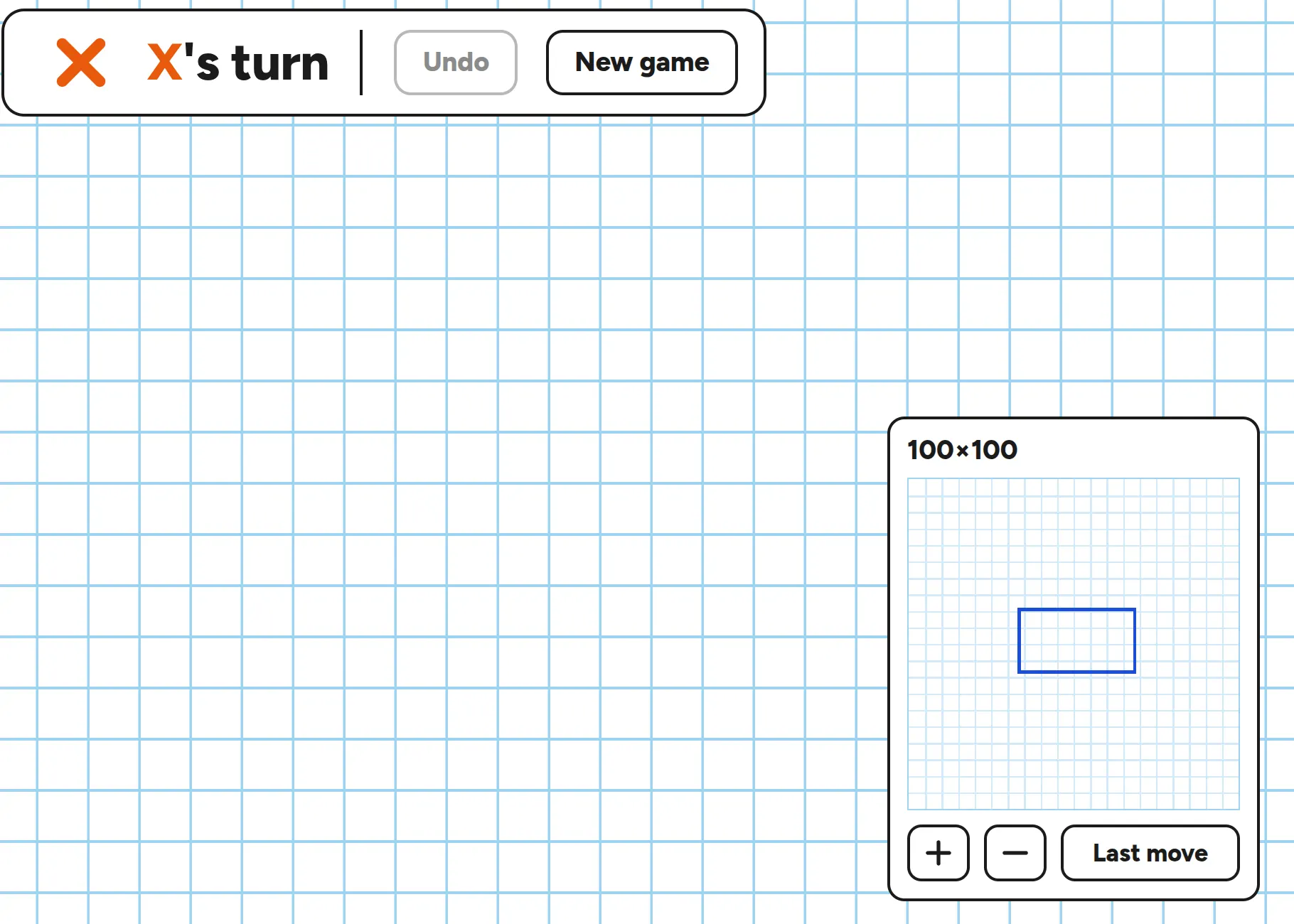
The board is far bigger than any screen. In a 1280×800 desktop window, the page drew 36 columns and 20 rows of squares at once, 720 of the 10,000, and each game starts with the middle of the board in view.
- Drag the board with the mouse or a finger to pan. A short press without moving places a mark.
- The + and − buttons change the square size in five steps: 20, 28, 36, 44 and 56 pixels. The default is 36 pixels, and by the page's code 44 pixels when the browser reports a touch screen; we have not tried that on a real touch device.
- The overview map shows the whole board with both players' marks as dots and a blue rectangle for what is on screen. Press or drag on the map to jump there.
- Last move brings the view back to the latest mark. When the AI plays outside the view, the view moves to its mark by itself.
- On a keyboard, press Tab to reach the board, move with the arrow keys, and press Enter or Space to place a mark. At the edge of the view, the view scrolls with you.
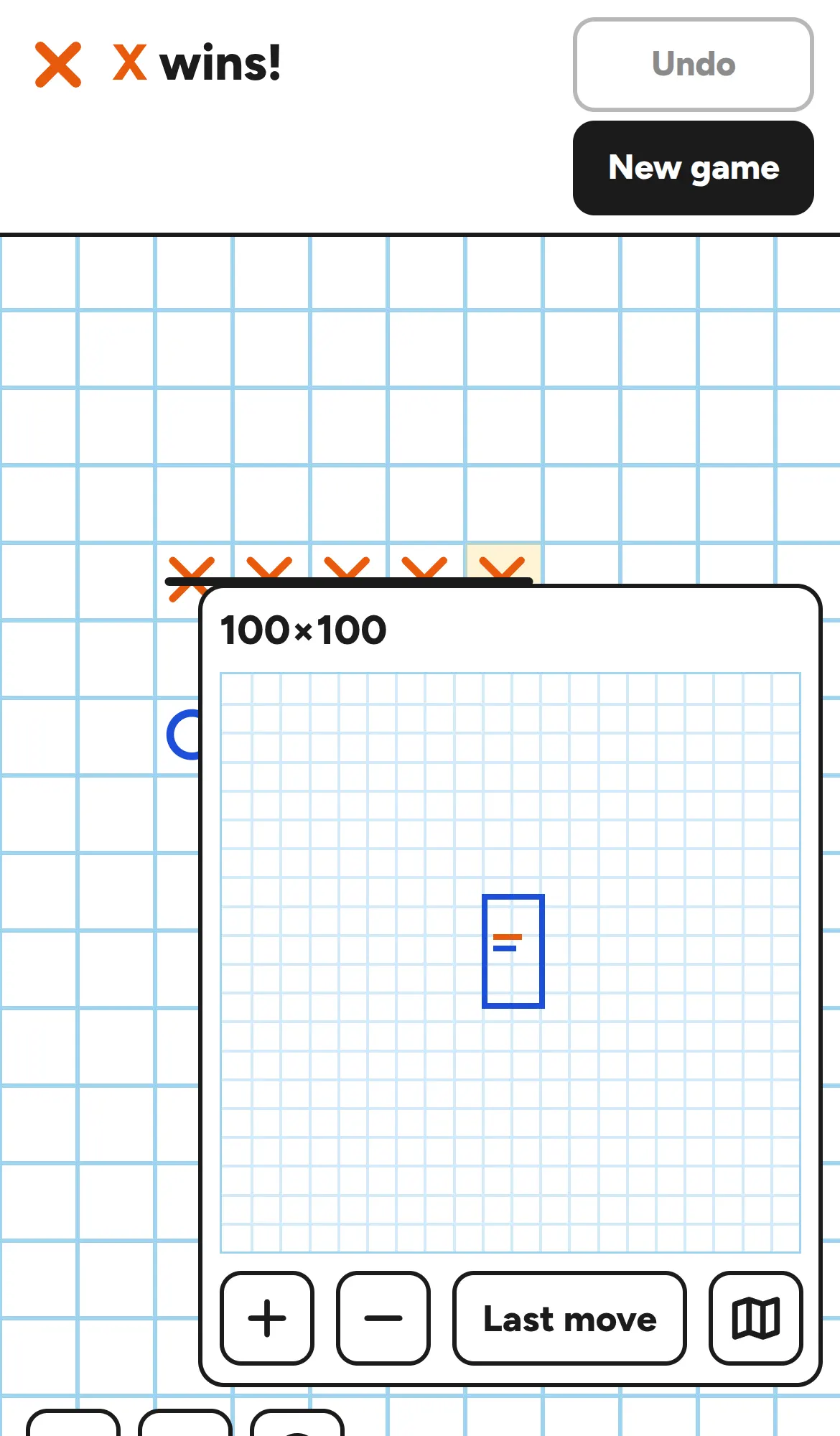
On a phone, the map sits behind a map button and opens as a panel over the board, next to the +, − and Last move buttons. At 390×844 in a desktop browser's phone emulation, the page did not scroll sideways, and the + and − buttons were 44 pixels wide.
Easy, Medium or Hard: how the AI plays
With vs AI picked, you play the computer. You are X unless you pick O next to Play as; that switch waits for the next game. With 2 Players picked, two people share one phone, tablet or computer, and the top of the game says whose turn it is. There is no network play, so you can't play someone on another device.
| Level | How the AI picks a square | In our test games |
|---|---|---|
| Easy | A random square next to marks already on the board. | Lost all 20 games against Medium and all 10 against Hard. |
| Medium | Finishes five when it can, blocks yours, and otherwise plays one of its three best-scoring squares. | Won all 20 games against Easy and lost all 10 against Hard. |
| Hard | Finishes five when it can, blocks yours, and otherwise searches ahead for about 0.7 seconds. | Won all 10 games against Medium and all 10 against Easy. |
Hard won every test game, so it is the strongest choice on this page, and Easy suits learning the rules. Medium and Hard games against another level lasted 9 to 30 moves in total. We ran the test games with this page's game code on a desktop computer. The first move switched sides each game. Hard has no guarantee of perfect play, and we have not measured it against skilled human players.
Hard thinks for about 0.7 seconds per move. In 274 Hard moves in our tests, the middle time was 706 milliseconds and the slowest 725. The AI thinks in a background worker, and when it has a win or a block to play it skips the search: in the one game we recorded, those moves took 3 and 0 milliseconds to compute. The page still waits about a third of a second before it places the mark. In an earlier check, the slowest frame while it thought was 73 milliseconds.
Tic Tac Toe 100x100 strategy
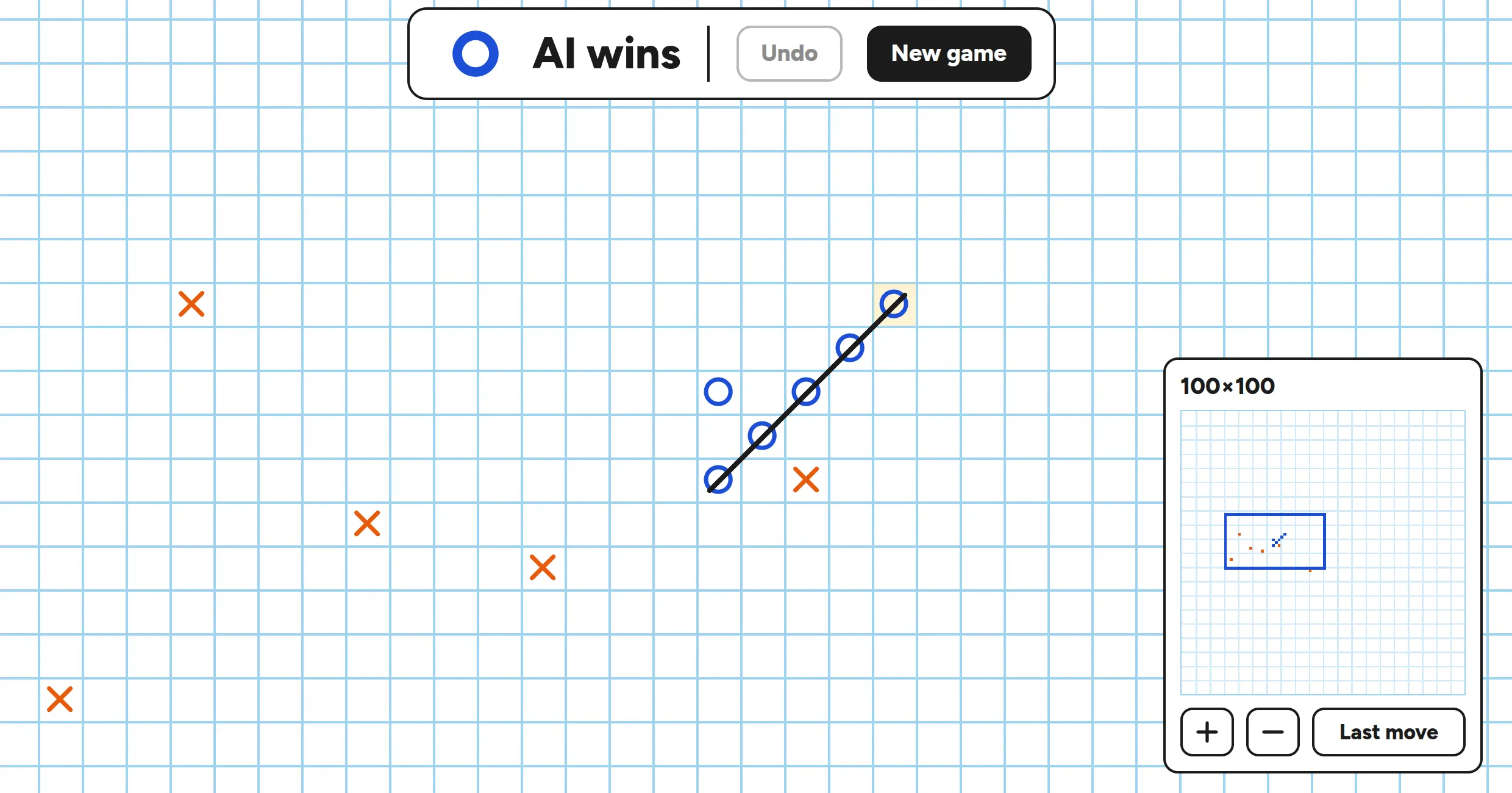
Each game starts in the middle of the board. In the AI test games we recorded, every mark stayed within rows and columns 45 to 53, nowhere near an edge, so the game is mostly about lines and blocks. A few ideas follow from the rules above.
- A line of four with both ends empty can't be stopped. Your opponent can block one end, and you finish five at the other. Block a line of three before it becomes that.
- Marks that sit next to each other can join in several directions at once. In our game against Hard, we spread our marks out and the AI won on its sixth move.
Random play shows why this takes planning. In 300 games where both sides played random squares, X won 169 and O won 131, and a game lasted 1,979 moves on average, from 662 to 3,089.
As for theory, L. Victor Allis's 1994 thesis reports that five in a row on a 15×15 board, with no opening rules, was solved by computer in 1992 as a win for the first player. Nobody has solved 100×100, and Jos Uiterwijk's 2019 paper on 4-in-a-row notes that a win on a smaller board has not been formally proven to carry over to every larger one. Wikipedia's article on m,n,k-games adds that no such game can be won by the second player with best play.
In short: five or more in a row wins on a 100×100 board, drag or use the map to move around, and start on Easy if you are new. The game at the top of this page starts on Medium.
Tic Tac Toe 100x100 FAQ
How do you play tic tac toe 100x100?
Two players, X and O, take turns marking any empty square on a 100×100 board. The first player to get five marks in a row, across, down or diagonally, wins. The board is bigger than the screen, so you drag it, use the + and − buttons, or use the overview map to move around.
How many in a row do you need to win on a 100x100 board?
Five. On this page five or more in a row wins, so a line of six counts too. Three in a row, which wins the 3×3 game, wins nothing here.
Is 100x100 tic tac toe the same as giant tic tac toe or big tic tac toe?
It is the on-screen kind. The same names also cover yard and floor games with big pieces. This page is a game on a screen with a 100×100 grid, 10,000 squares, and five in a row wins.
Can I play tic tac toe 100x100 against the computer?
Yes. Pick vs AI and choose Easy, Medium or Hard. Hard searches for about 0.7 seconds per move. In our test games it beat Medium 10 times out of 10 and Easy 10 times out of 10.
Can I play 100x100 tic tac toe with a friend?
Yes, on one device. Pick 2 Players and pass the phone, tablet or computer between turns. The page can't connect two devices, so there is no network play.
Can you play tic tac toe 100x100 on a phone?
Yes, in a phone browser. Drag the board to move, use the + and − buttons to change the square size, and open the overview map with its button. We checked it at 390×844 in a desktop browser's phone emulation; we have not tried it on a real phone.
Can the first player always win on a 100x100 board?
Nobody has shown it for this exact board, and we found no source that does. L. Victor Allis solved five in a row on a 15×15 board by computer in 1992 and found a first-player win, as his 1994 thesis reports. Jos Uiterwijk's 2019 paper on 4-in-a-row notes that for games of this kind it has not been formally proven that a win on one board carries over to every larger board. Wikipedia adds that no board of this kind lets the second player force a win.
How long does a game of tic tac toe 100x100 take?
When the AI levels played each other in our tests, games lasted 9 to 30 moves in total. When both sides played random squares, a game lasted about 1,980 moves, because random marks rarely line up.
Does the game save my score?
No. The 100×100 board shows no score line and saves none. The page remembers only whether you turned the sound off.
Last checked on : we played a 2 Players game and a game against Hard in Chrome at 1280×800, and a 2 Players game at 390×844 in phone emulation. The test games (20 Medium against Easy, 10 Hard against Medium, 10 Hard against Easy, 4 Hard against Hard) and the 300 random games ran on this page's game code in Node.js 24 on an Intel Xeon E5-2696 v3.
Sources, read on November 16, 2026: L. Victor Allis, "Searching for Solutions in Games and Artificial Intelligence", PhD thesis, 1994 (five in a row on 15×15 solved in 1992 as a first-player win); Jos W.H.M. Uiterwijk, "Solving Strong and Weak 4-in-a-Row", IEEE Conference on Games 2019 (a win on one board is not formally proven to carry over to larger boards); Wikipedia, "m,n,k-game" (the second player can't force a win).